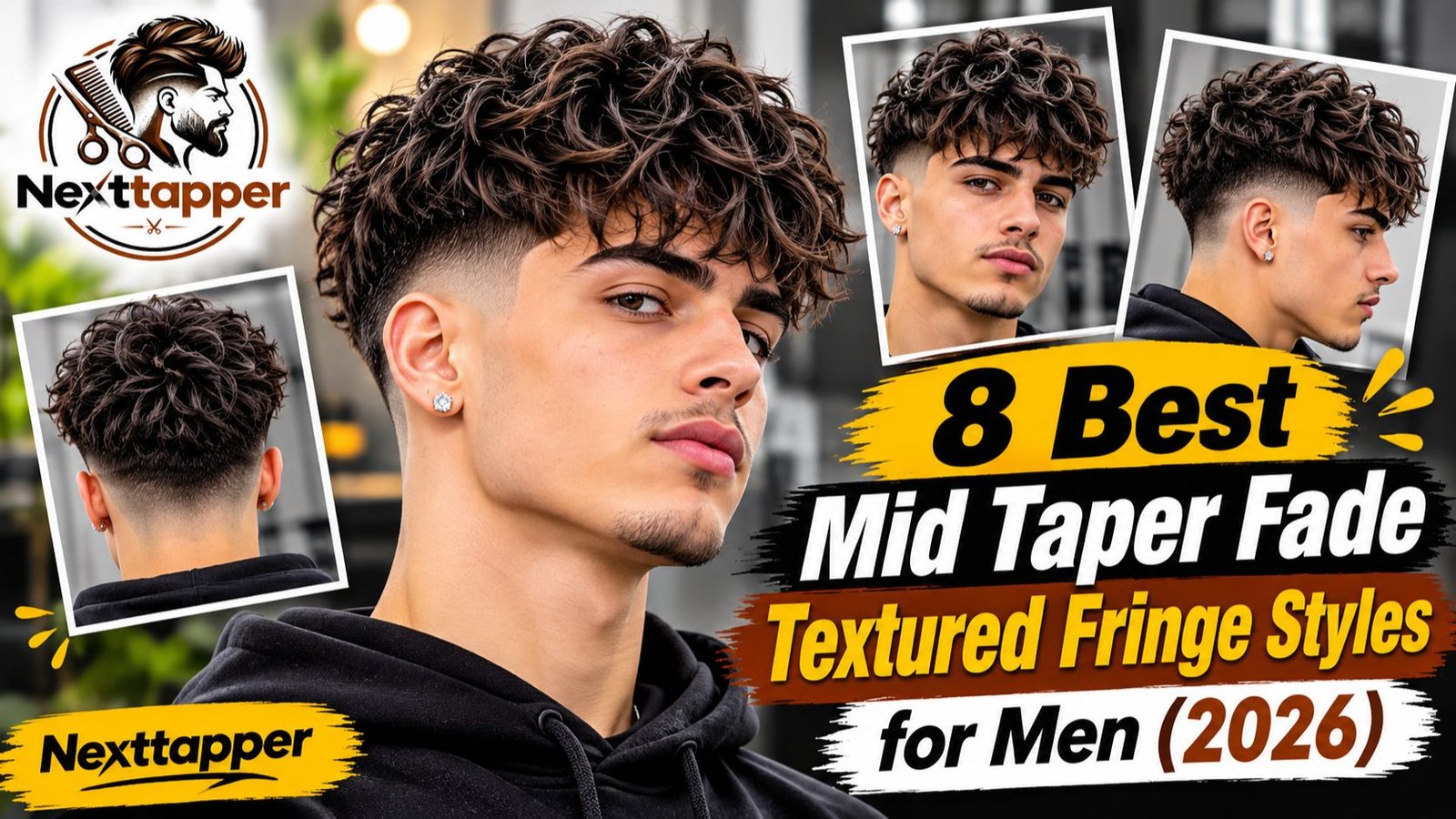

The mid taper fade textured fringe is one of the few haircuts that looks sharp in a boardroom and relaxed at a weekend barbecue. The sides stay short and tidy. The top stays longer, broken up, and full of movement.
That contrast is the whole appeal. You get a clean outline that frames your face, plus a fringe that looks effortless without needing an hour in front of the mirror.
This guide covers eight proven variations, how the cut works, and which version suits your hair type, face shape, and age. You will also get exact guard numbers to hand your barber, a realistic maintenance plan, and a comparison with other popular fringe cuts.
Quick answer: A mid taper fade textured fringe is a haircut where the sides and back gradually shorten, starting around the temple, while the hair on top is left 2 to 4 inches long and cut with texture so it falls forward in separated pieces.
Read also This: Mid Taper Fade with Dreads: 15 Styles, Tips & Photos (2026)
Quick Comparison of the 8 Styles
| Style | Best For | Top Length | Styling Effort |
| Classic Textured Fringe | Everyday wear, first-timers | 2–3 in | Low |
| Choppy Textured Fringe | Fine to medium straight hair | 2–3 in | Low |
| Textured Fringe with Volume | Thin or flat hair | 3–4 in | Medium |
| Textured Fringe with Blowout | Thick, wavy hair | 3–4 in | Medium |
| Wavy Textured Fringe | Natural waves | 3–4 in | Low |
| Curly Textured Fringe | Curly and coily hair | 3–5 in | Medium |
| Side-Swept Textured Fringe | Office and formal settings | 3–4 in | Medium |
| Textured Fringe with Design | Bold, creative looks | 2–3 in | High |
Classic Textured Styles
These two are the foundation. If you have never worn a fringe before, start here.
1. Classic Textured Fringe
This is the cut most barbers picture when you say “mid taper fade textured fringe.” The sides blend from short to longer around the temple. The top is left about 2 to 3 inches long and cut so the ends look uneven and soft instead of blunt.
Style it by pushing the fringe forward and slightly to one side with a matte clay. You want visible separation, not a flat curtain.
Why it works: It suits almost every face shape and requires very little product. It also grows out gracefully, which matters if you stretch your appointments.
2. Choppy Textured Fringe
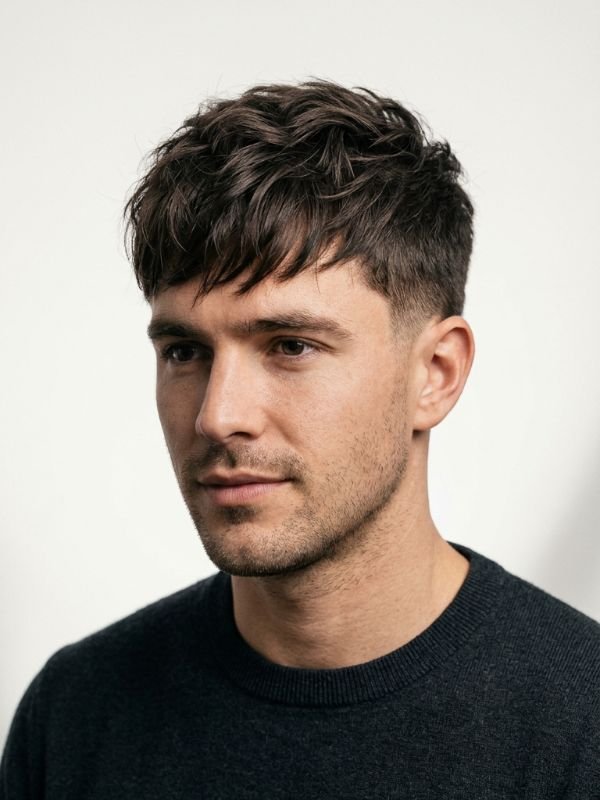
The choppy version uses point cutting, a technique where the barber snips into the ends of the hair at an angle. This removes weight and creates deliberate, jagged pieces.
The result looks bolder than the classic cut. It is a strong choice for straight, fine-to-medium hair that tends to lie flat, because the cut itself builds the texture that your hair would not hold on its own.
Styling tip: Use a small amount of texture powder or sea salt spray on damp hair, then rough-dry with your fingers.

Volume-Focused Variations
If your hair lacks lift, these two cuts add body at the front without making the style look overdone.
3. Textured Fringe with Volume
Here the top is left slightly longer, around 3 to 4 inches, with layers cut through the crown. The extra length gives the hair weight to lift from the root rather than collapse.
Blow-dry the front upward and back first, then bring the fringe forward. Finish with a light-hold paste. The mid taper keeps the sides slim, so the volume reads as intentional instead of bulky.
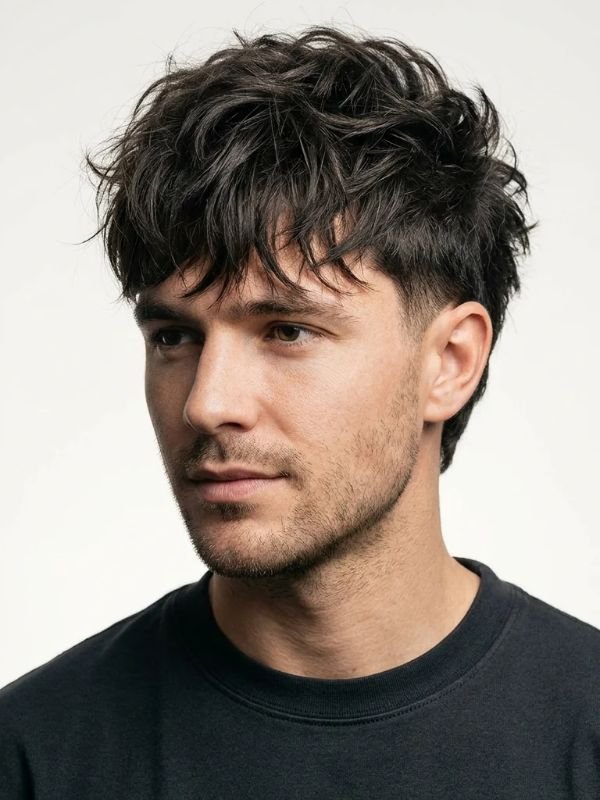
4. Textured Fringe with Blowout
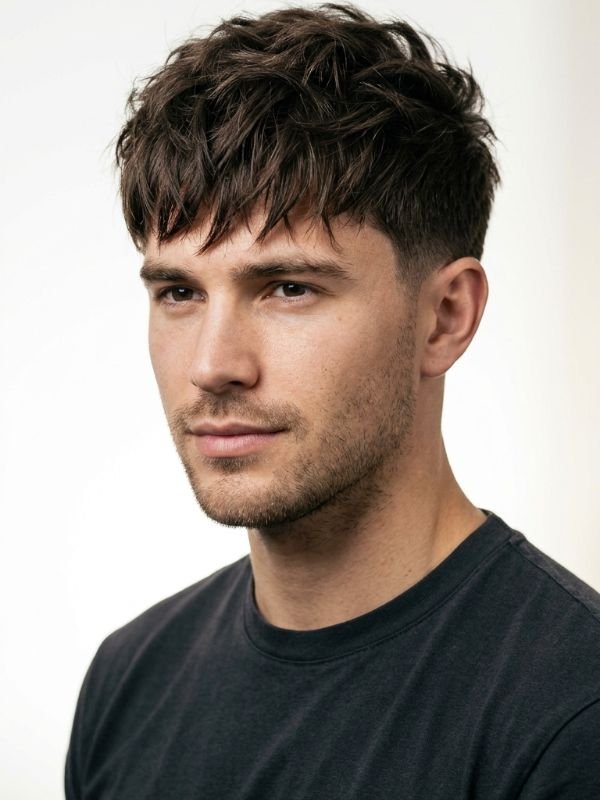
A blowout is a styled finish, not a separate haircut. You dry the hair with a brush or your fingers while directing it up and over, then lock it in with a medium-hold product.
This version pairs especially well with thick or slightly wavy hair. The mid taper stops the shape from getting too wide at the sides. Expect it to take about five minutes once you learn the motion.
Wavy and Natural Texture Styles
Here you stop fighting your hair and let it do most of the work.
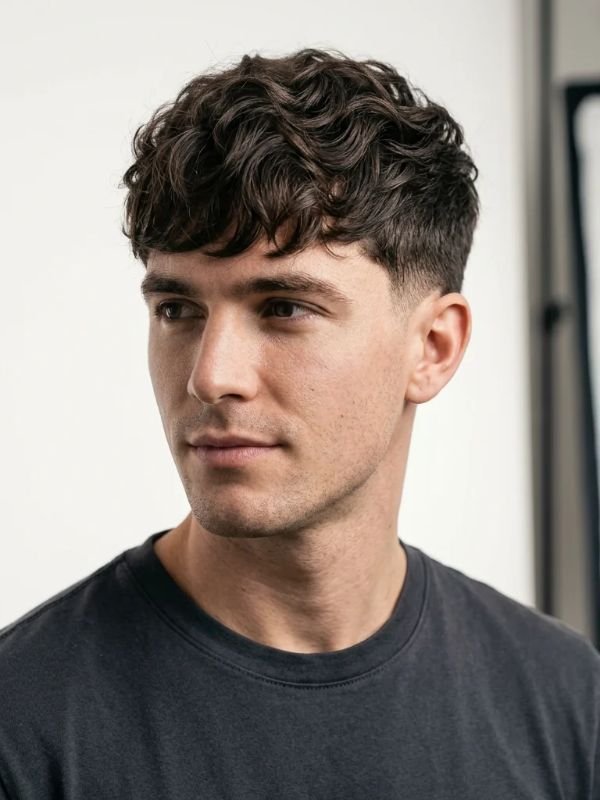
5. Wavy Textured Fringe
Waves already carry built-in texture, so the barber’s job is to control the shape. Leave 3 to 4 inches on top and thin out the bulk so the waves sit in loose, even pieces.
Apply a curl cream or light mousse to damp hair, then air-dry or diffuse. Avoid heavy gel. It will weigh the waves down and push the fringe into a flat, stringy line.
6. Curly Textured Fringe
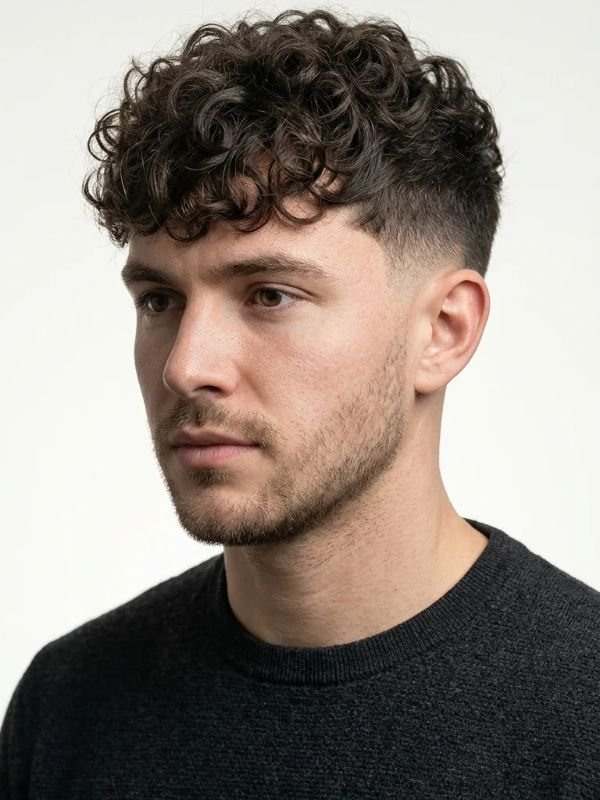
Curls fall onto the forehead in soft spirals above a clean taper. It is a standout look for men with Type 3 or Type 4 curls because the tight sides highlight the curl pattern on top.
Ask your barber to cut curls dry or damp, not soaking wet, since curls spring up as they dry and can end up shorter than planned. Keep the top between 3 and 5 inches so the curls have room to form.
Detail and Combination Styles
These versions add direction or personality to the base cut.
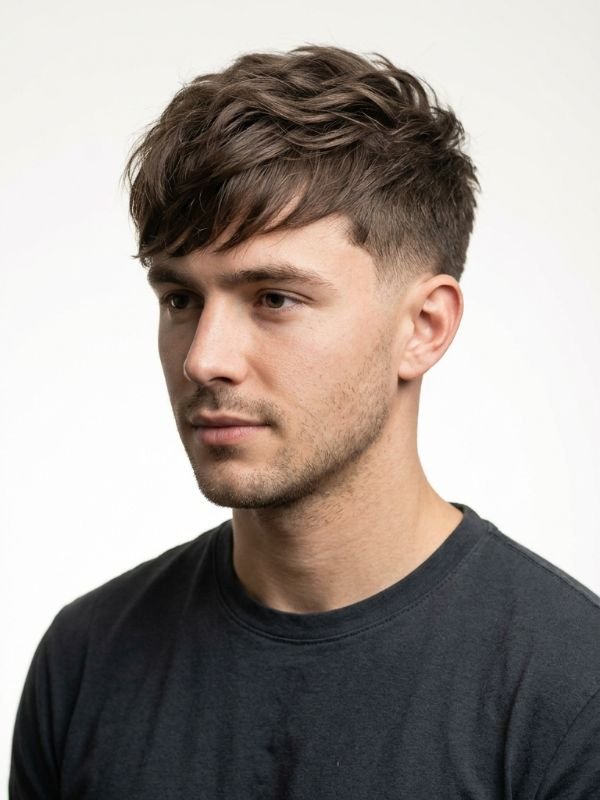
7. Side-Swept Textured Fringe
The fringe sweeps across the forehead at an angle instead of falling straight forward. It is a polished option for work and formal events, and it quietly softens a wide forehead.
Part the hair lightly with a comb, then roughen the ends with your fingers so it does not look too neat. A bit of pomade or cream gives a controlled finish without shine overload.
8. Textured Fringe with Design
This pairs the mid taper with a shaved line, a small pattern, or a sharply defined part. It is the highest-maintenance cut on the list because the detail fades quickly.
If you want to try it, start with a simple hard part. A fine line near the temple is easy for most barbers to execute and easy to grow out if you change your mind.

Mid Taper Fade Textured Fringe Explained: What Makes the Texture Work
Two separate haircuts work together here, and understanding each one helps you ask for exactly what you want.
The mid taper. The sides and back are cut short at the bottom and gradually get longer as they climb. A mid taper begins its blend around the temple, roughly in the middle of the side of the head. It sits between a low taper, which stays near the ears and neckline, and a high taper, which starts near the crown.
The textured fringe. The top is cut longer, then broken up with point cutting, slide cutting, or thinning shears. The goal is uneven ends. Blunt, straight-across ends look flat, while uneven ends separate and catch product.
The texture comes from the cut first and the product second. A good cut makes styling easy. A poor cut makes you rely on gel to fake a result.
Here are the key terms you will hear in a barbershop:
- Point cutting: snipping vertically into the ends to create a soft, ragged edge
- Slide cutting: gliding open shears along the hair to remove weight
- Weight line: where long hair meets short hair; a taper blurs it
- Disconnection: a visible gap between the top and sides, which this cut avoids
Why Textured Fringe Is Still Everywhere in 2026
Men keep returning to this haircut for a handful of practical reasons.
- It looks current without looking forced. The cut leans on natural movement instead of rigid shape.
- The mid taper is a safe middle ground. It is cleaner than a low taper and less aggressive than a high skin fade.
- It works across settings. The same cut can go office-friendly or casual just by changing product.
- It flatters many head shapes. Length on top and shorter sides create balance.
- It grows out well. There is no hard line to ruin, so a week or two past schedule is forgivable.
Barbers and men’s grooming editors have described the fringe-with-taper combination as one of the defining cuts of the last few years, and the demand has barely cooled. When a cut stays popular that long, it usually means it solves a real problem: look sharp, spend little time.
Pros and Cons: What You’re Signing Up For
| Pros | Cons |
| Fits most hair types and face shapes | Fade needs touch-ups every 2–4 weeks |
| Quick daily styling (3–5 minutes) | Very fine hair may need volume products |
| Looks good dressed up or down | Cowlicks at the front can fight the fringe |
| Grows out without an awkward stage | Fringe in your eyes can annoy at the gym |
| Easy to explain to any barber | Receding hairlines limit forward styling |
Bottom line: If you can commit to a barber visit about once a month and spend a few minutes with product, the trade-off is hard to beat.
Choosing by Hair Type: What Actually Holds Texture
Your hair’s natural behavior decides which variation will look best. Match the cut to the hair you have, not the hair in the photo.
Straight Hair
Straight hair shows texture clearly but loses it fast. Ask for point cutting and a slightly longer top, around 3 inches. Use a matte clay or texture powder to add grip, and avoid oily products that slick it down.
Wavy Hair
Wavy hair is the easiest to work with. Leave enough length for the wave to show, usually 3 to 4 inches. A sea salt spray or light cream keeps the pattern defined without crunch.
Thick Hair
Thick hair needs weight removal. Ask your barber to thin the top with slide cutting so the fringe does not puff out. A medium-hold paste tames volume better than a strong gel, which can make thick hair look stiff.
Curly Hair
Curls need room and moisture. Keep the top 3 to 5 inches and ask for a taper that stays clean but not too tight. A leave-in conditioner or curl cream is more useful here than any styling clay.
Face Shape Matchups
A good barber adjusts length and direction to balance your face. Use this as a starting guide, not a strict rule.
Oval Face
Most variations work. The classic or side-swept versions highlight balanced proportions without hiding anything.
Round Face
Add height and keep the sides tight. The textured fringe with volume elongates the face. Avoid a very long, flat fringe, which adds width.
Square Face
The soft, uneven fringe offsets a strong jaw. Choppy and classic styles pair well because the texture softens angular lines.
Heart-Shaped Face
A fringe that covers part of the forehead balances a wider brow and narrower chin. The side-swept version is a smart pick.
Long Face
Skip extra height. A fringe that falls forward shortens the face visually. Keep the top moderate in length and avoid tall quiffs.
Diamond Face
Cheekbones are the widest point here, so a fringe that adds width at the forehead helps. Choppy and wavy versions work nicely.
Rectangular Face
Treat it like a long face. A forward-falling fringe and a slightly fuller top create better balance than a swept-back style.
Age Group Breakdown
Teenagers
Teens often want a bolder, messier look. The choppy or wavy versions fit well, and school dress codes rarely object to a mid taper. Keep products simple, such as a light paste or sea salt spray.
Young Men
For men in their twenties and thirties, almost every style on this list works. This is the age group where design variations and blowouts are most common.
Professional Men
A side-swept or classic version keeps the cut workplace-appropriate. Use a lower-shine product and keep the fringe slightly tidier. Book touch-ups every three weeks to keep the taper crisp.
Talking to Your Barber: The Exact Guard Numbers
Words like “short on the sides” mean different things to different barbers. Guard numbers remove the guesswork. The sizes below are widely used reference points. Always confirm with your barber, since clippers and blending styles vary.
Taper Fade Guard Sizes
| Zone | Common Guard | Approximate Length |
| Neckline and around ears | Zero to #0.5 or #1 | Skin to 1/16 in |
| Lower sides (just above ears) | #1 to #1.5 | 1/8 to 3/16 in |
| Mid-point at temple | #2 to #3 | 1/4 to 3/8 in |
| Upper sides blending into top | #4 | 1/2 in |
| Top (fringe) | Scissor cut | 2–4 in |
What to say: “Mid taper, starting the blend at the temple, around a number 2 to 3 there, going down to a number 1 at the neckline. Leave 3 inches on top, point cut, with the fringe forward.”
Bring a photo and mention your styling routine. If you only spend two minutes on your hair each morning, tell your barber so they can cut accordingly.
Video Guide: Watch the Texture Get Cut In
Photos show the finished cut. Video shows how it gets there. Search for a barber tutorial on this cut and watch for these details:
- How the barber blends the taper with clippers over comb
- How the top is point cut into the ends instead of cut straight across
- How the barber checks the fringe by lifting and releasing it
- How the final styling product is applied to damp or dry hair
Watching even one tutorial helps you describe what you want and recognize a good result in the chair. Look for videos from working barbers who show the cut in full, not only the final shot.
Common Mistakes That Flatten the Texture
Most problems with this cut come from a handful of repeat errors.
- Cutting the fringe blunt. Straight-across ends look heavy and flat. Ask for point cutting.
- Too much product. More is not better. A pea-sized amount of paste or clay is usually enough.
- Using the wrong product. High-shine gels flatten texture. Choose matte options.
- Styling on soaking wet hair. Products spread unevenly and weigh the hair down. Towel dry first.
- Ignoring your cowlick. If your front hairline has a strong whorl, tell your barber so they can cut with it, not against it.
- Washing too often. Daily shampooing strips natural oils and leaves hair limp.
- Skipping appointments. The fade turns fuzzy after three weeks and the fringe loses its shape.
Maintenance Reality Check
This haircut is easier than most to live with, but it is not zero effort.
Daily Styling
- Towel dry your hair until it is damp, not dripping.
- Apply a light spray or cream if you want extra grip.
- Rough-dry with a blow dryer on medium heat, using your fingers to push the fringe forward.
- Warm a small amount of product between your palms.
- Rake it through the top and shape the fringe with your fingertips.
Total time: three to five minutes.
Products That Work Best
| Product | Best For | Finish |
| Matte clay | Thick or straight hair | Strong hold, no shine |
| Texture powder | Fine, flat hair | Light lift, dry feel |
| Sea salt spray | Wavy hair | Beachy, loose |
| Curl cream | Curly hair | Soft definition |
| Light paste | All types | Natural, flexible |
Washing Routine
Wash two to three times a week with a gentle shampoo. Rinse with lukewarm water on off days if your hair feels oily. Use conditioner on the lengths if your hair is dry, wavy, or curly.
Touch-Up Frequency
| Goal | Visit Every |
| Keep the fade razor-sharp | 2 weeks |
| Stay neat for work | 3 weeks |
| Casual, relaxed look | 4 weeks |
| Maximum stretch before it looks messy | 5 weeks |
Because the taper begins at the temple, stubble shows up around the ears and neck within two to three weeks. A quick neckline cleanup between full cuts can extend the look.
Textured Fringe vs Other Fringe Styles
If you are still deciding, here is how the textured fringe stacks up against its closest relatives.
Textured Fringe vs Blunt Fringe
A blunt fringe has a straight, uniform edge across the forehead. It looks sleek and deliberate but needs straight, thick hair to work. A textured fringe is softer and more forgiving. If your hair is fine, wavy, or has any cowlick, the textured version is the safer bet.
Textured Fringe vs Edgar Cut
The Edgar cut features a very short, blunt fringe cut straight across, usually paired with a sharp fade. It makes a bold graphic statement. The textured fringe is longer, looser, and more flexible. Choose the Edgar for a strong, defined look and the textured fringe for something easier to restyle.
Textured Fringe vs Curtain Fringe
A curtain fringe parts in the middle and falls to either side of the forehead. It needs longer hair and leans toward a relaxed, retro feel. The textured fringe falls forward or sideways and works on shorter lengths, so it suits a wider range of men and workplaces.
| Feature | Textured Fringe | Blunt Fringe | Edgar Cut | Curtain Fringe |
| Edge | Soft, uneven | Straight | Straight, very short | Soft, parted |
| Hair length needed | Short to medium | Medium | Short | Medium to long |
| Styling effort | Low | Low | Low | Medium |
| Works with waves | Yes | Rarely | Rarely | Yes |
Conclusion
The mid taper fade textured fringe lasts because it gives you a clean frame and a relaxed top in one cut. You can push it toward volume, waves, curls, or a polished side sweep, and a competent barber can adapt it to nearly any hair type or face shape.
To get the result you want, remember three things. First, tell your barber the guard numbers and ask for point cutting on top. Second, pick products that match your hair, with matte clay for thick hair, powder for fine hair, and cream for curls. Third, schedule a touch-up every three to four weeks to keep the taper crisp.
Take a photo, pick one of the eight styles above, and book your next appointment. Small tweaks in length and styling can make the same base cut feel like a different haircut every time.

1 thought on “8 Best Mid Taper Fade Textured Fringe Styles for Men (2026)”