
A plain mid taper fade is a clean haircut. Add a design, and it becomes yours.
That is the appeal of the mid taper fade with design. The fade does the heavy lifting by blending short sides into longer hair on top. The design adds a personal detail, whether that is a single sharp line, a small symbol or a full geometric pattern. It takes a good cut and gives it a signature.
This guide walks through what the cut is, why it is trending in 2026, and the pros and cons. You will see 10 design ideas, learn how to match them to your hair type, face shape and age, and get barber scripts you can use word for word. We also cover the mistakes that spoil a design, how to keep it sharp, and how it compares with other styles.
What Is a Mid Taper Fade with Design?
A mid taper fade starts halfway up the sides and back of the head. The hair is shortest near the ears and neckline and gradually lengthens as it moves up toward the top. “Mid” describes where the fade begins, roughly between the temple and the ear. “Taper” describes the gradual change in length.
A design is a pattern or shape cut into the faded section using clippers, a trimmer or a straight razor. The barber carves the lines into the shorter hair, so the pattern shows clearly against the skin or the fade.
How the cut is built
- The barber maps the fade line, usually around the temple level.
- Clipper guards step the hair from long to short.
- The fade is blended until there is no visible line between lengths.
- The design is outlined with a trimmer, then refined with a razor.
- The top is cut, textured and styled to match.
Taper fade vs skin fade
A taper keeps some hair length at the shortest point, so the transition looks soft. A skin fade goes all the way down to bare skin, which makes designs pop more. Many men choose a mid taper with a skin-level section only where the design sits. That gives you contrast without a harsh look all over.
Why Mid Taper Fade with Design Is So Popular in 2026
The fade itself is nothing new. What has changed is how people use it.
It balances boldness and professionalism. A mid fade sits between the subtle low fade and the dramatic high fade. Add a small design and the cut stays office-safe while still looking considered.
It works with most tops. Textured crops, curls, quiffs, fringes and buzz cuts all sit well on a mid taper. The design simply adds detail underneath.
Social media rewards detail. Designs photograph clearly from the side and back, so they travel well on short-form video and photo feeds. Barbers also use them to show off precision.
It is customizable. You can choose a tiny line or an elaborate pattern. The same base cut supports both.
It suits many hair types. The look is not limited to one texture, which is why barbers in very different communities offer it.
Pros and Cons
Think through the trade-offs before you commit.
✅ Pros
- Adds personality without changing your whole haircut
- Mid height works on nearly every head shape
- Easy to start small and add more later
- Designs are temporary, so there is low commitment
- Works for school, work and weekends when kept simple
- Pairs well with beards and sharp lineups
❌ Cons
- Designs fade quickly as hair grows, often within a week or two
- Needs a skilled barber with a steady hand
- Detailed patterns can take longer and cost more
- Some workplaces and schools have grooming rules
- Poorly placed designs can look uneven or crowded
If you like to refresh your cut every two to three weeks, the pros win comfortably.
10 Best Mid Taper Fade with Design Ideas
Each idea below includes a short description and what to tell your barber. Bring a reference photo too. It removes guesswork.
<!– Image placement note: add one original or properly licensed photo per design. Suggested alt text is shown in each image line. –>
Classic Line Designs
Lines are the entry point into hair art. They are quick to cut, easy to grow out and hard to get wrong.
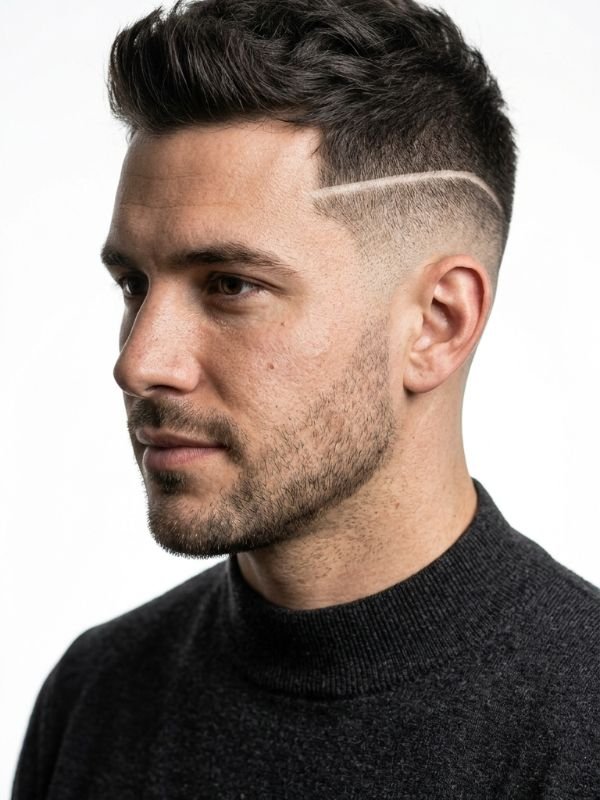
1. Single Line Design
Mid taper fade with a single razor line on the side
One clean line is carved into the fade, usually above the ear or running back from the temple. It is the least risky design and looks smart on short hair and buzz cuts.
Best for: First-timers and conservative workplaces. Ask for: “A mid taper fade with one thin line above the ear, parallel to my hairline.”
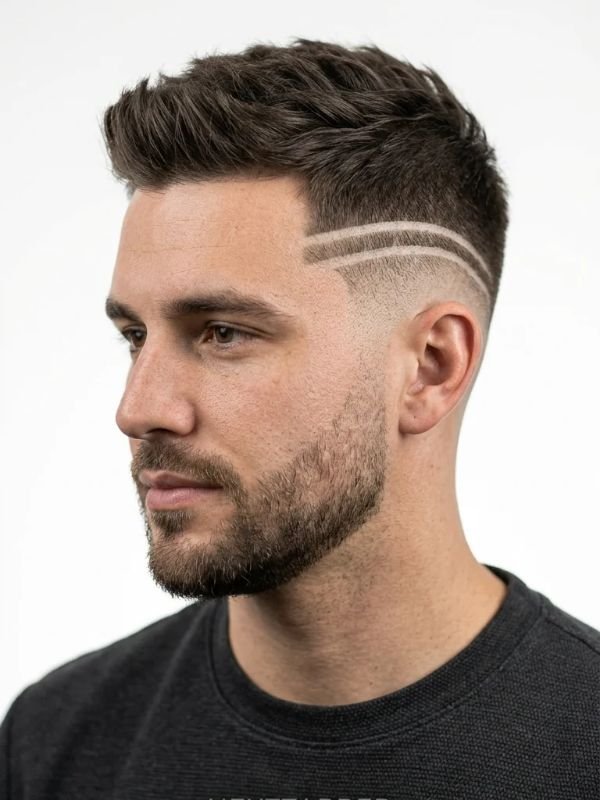
2. Double Line Design
Mid taper fade with two parallel razor lines
Two parallel lines add rhythm and make the design look more deliberate. Keep the gap between them even, since uneven spacing is the first thing people notice.
Best for: Men who want something more visible than one line. Ask for: “Two parallel lines, about a finger’s width apart, following the curve of my head.”
3. Side Part Line Design
Mid taper fade with a hard razor part
A hard part is shaved into the top or side. It creates a sharp divide between the longer top and the fade, and pairs naturally with a slick-back or side-swept style.
Best for: Formal looks, quiffs and combed-over tops. Ask for: “A hard part on the left, cut with a razor, with a mid taper fade.”
Symbol & Shape Designs
These designs use recognizable forms. They are great for personalizing the cut.
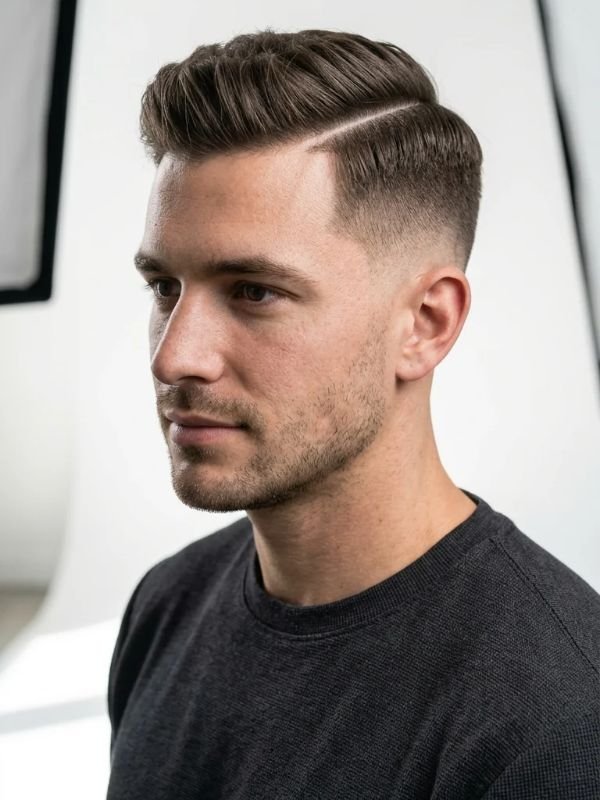
4. Cross Design
Mid taper fade with a small cross design
A small cross cut into the fade, often near the back or side. It is meaningful for many people and looks crisp when the lines are straight. Keep it small so it does not dominate the cut.
Best for: A personal symbol with a clean look. Ask for: “A small cross on the back left, about the size of a coin.”
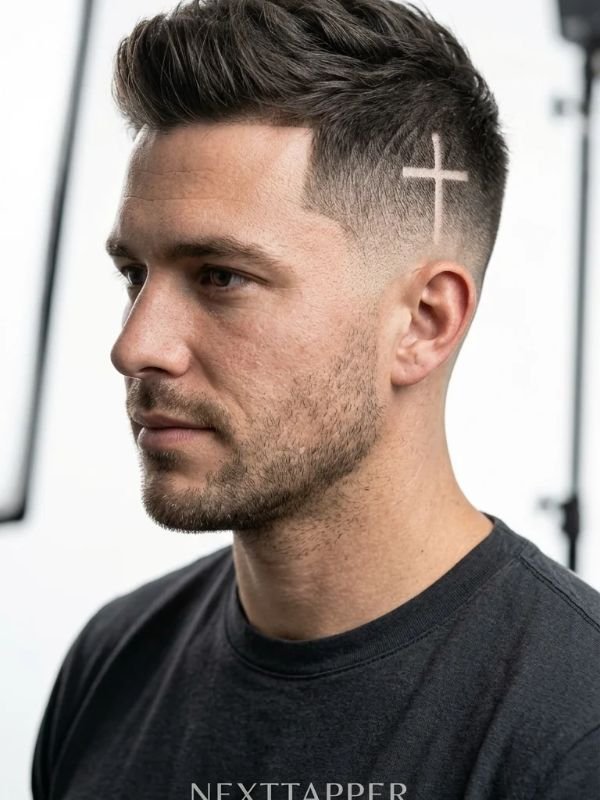
5. Star Design
Mid taper fade with a five-point star
A star adds a playful touch. The points need to be sharp and even, so choose a barber who has done them before. They look best on skin-level sections.
Best for: Younger men and creative styles. Ask for: “A five-point star behind my right ear, with the fade blended around it.”
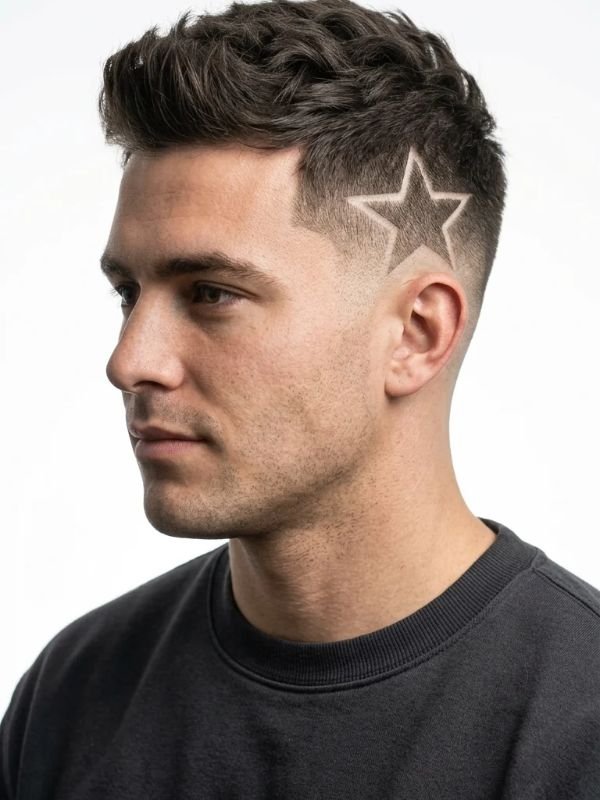
6. Zigzag Design
Mid taper fade with a zigzag pattern
A zigzag line has movement and energy. It can run along the fade line or sit separately above it. Because the angles are sharp, it looks great on a clean mid taper.
Best for: A sporty, confident look. Ask for: “A zigzag along the fade line on both sides, with sharp angles.”
Bold Statement Designs
Bigger patterns need more skill and more upkeep, but they get attention.
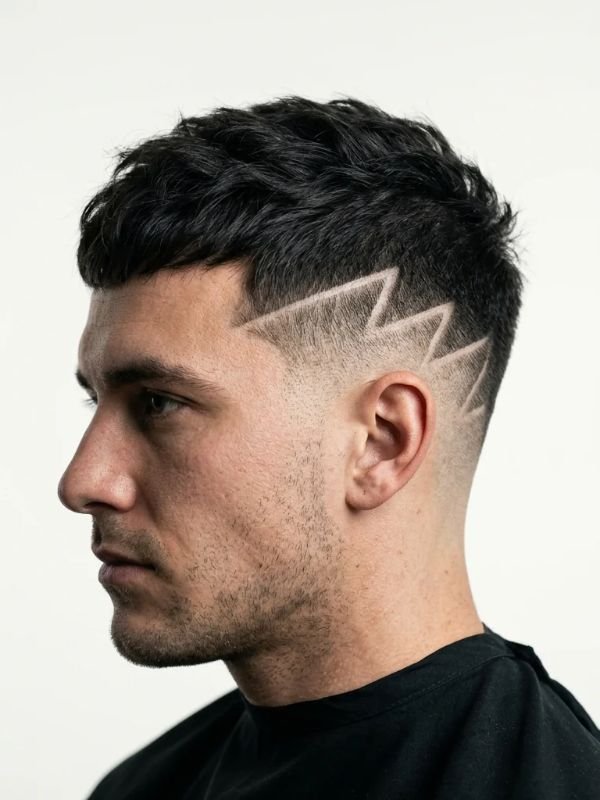
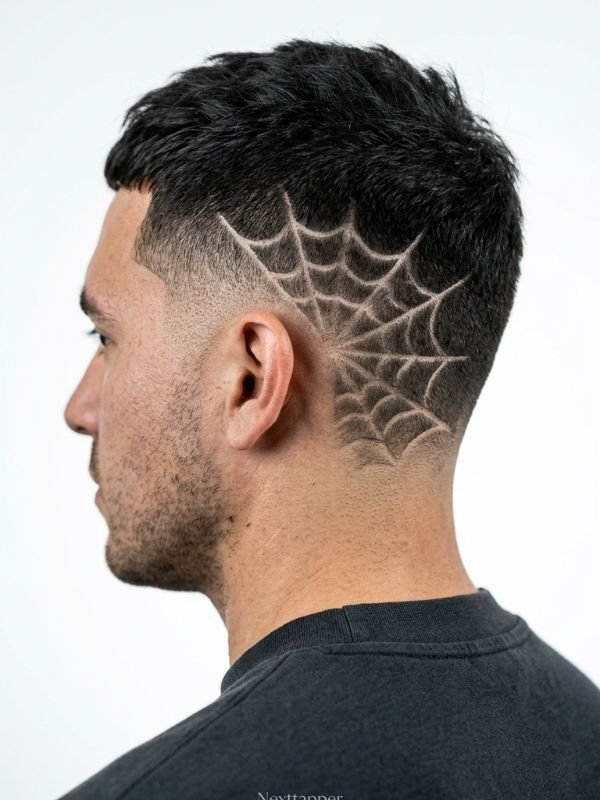
7. Spider Web Design
Mid taper fade with a spider web pattern
A web is built from curved lines that radiate from a central point. It sits best at the back or side and needs a skin-level section to show clearly. Expect a longer appointment.
Best for: Men who want a standout look. Ask for: “A spider web design on the back right, fading into the taper.”
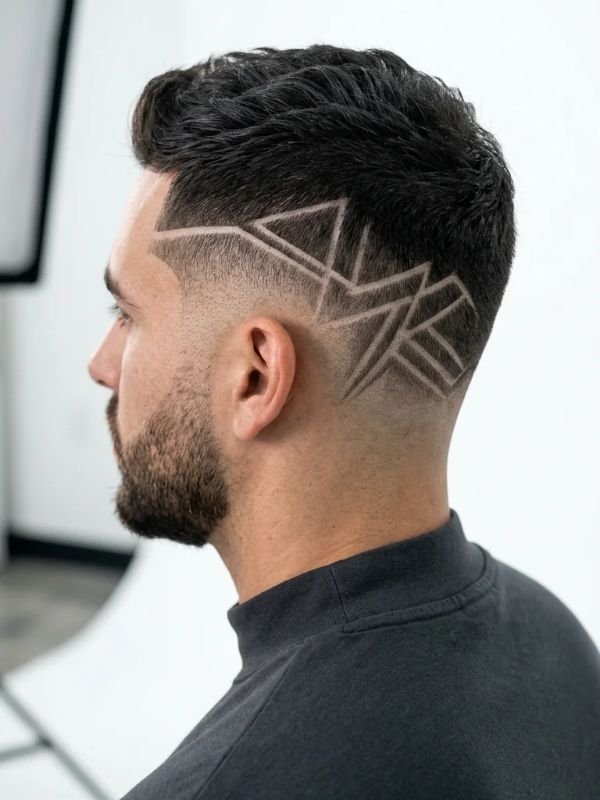
8. Geometric Pattern Design
Mid taper fade with geometric triangles and lines
Triangles, hexagons and straight lines combine to form a sharp, modern pattern. It looks like architecture on your head. Precision matters, because a small error is obvious.
Best for: Detail lovers and short crops. Ask for: “A geometric pattern with triangles and straight lines across the left side.”
Placement Variations
Where the design goes changes how the cut looks and how visible it is.
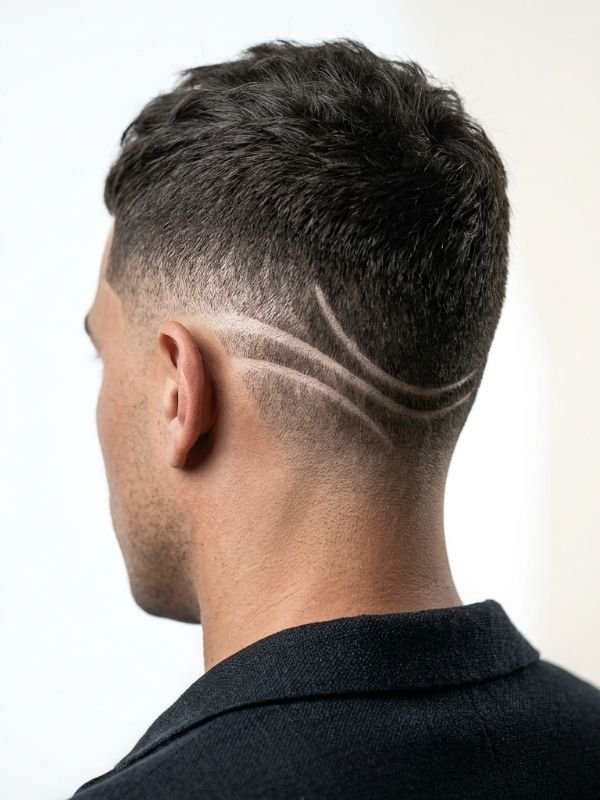
9. Back Design
Mid taper fade with a design at the back of the head
A design at the nape or lower back of the head stays hidden when you wear a hat or hoodie. It is a good way to try hair art without it being the first thing people see.
Best for: Subtle personality and workplaces with grooming rules. Ask for: “A small design at the center back, not too wide, with a clean taper around it.”
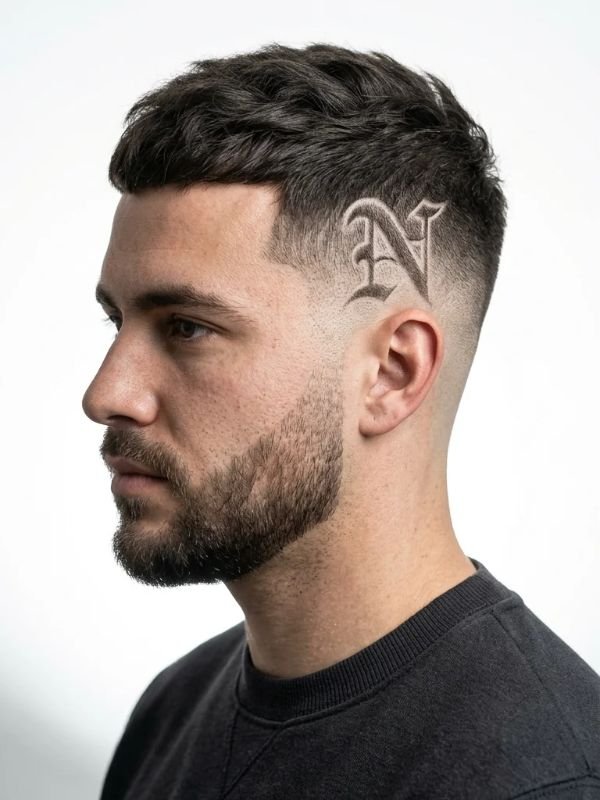
10. Initial or Letter Design
Mid taper fade with an initial cut into the side
Your initial, a number or a short word. Keep the letter simple, since fine details get lost as the hair grows. Block letters look cleaner than script.
Best for: Sports fans, personal branding and gifts. Ask for: “My initial in block letters, behind the right ear, with a skin section around it.”
How to Choose the Right Design for Your Hair Type
Your hair texture decides how crisp a design looks. Here is a quick overview.
| Hair Type | Best Design Style | Key Tip |
| Straight | Lines, geometric patterns | Clean lines show up well, so be precise |
| Curly | Single lines, symbols | Keep the design simple and let curls frame it |
| Wavy | Side part, zigzag | Use light product to avoid weighing hair down |
| Coily and Afro-textured | Lines, letters, geometric designs | Short sides give the sharpest result |
| Fine | Single line, small symbol | Keep the top slightly longer for fullness |
Straight Hair
Straight hair shows every line, which makes it a great canvas. Lines, geometric patterns and hard parts all work. The downside is that mistakes show too, so the barber’s skill matters.
Curly Hair
Curls on top contrast well with a tidy faded side. Stick to simple designs like a line or a small symbol so the cut does not feel busy. A curl cream on the top keeps the whole look neat.
Wavy Hair
Wavy hair is flexible. A side part or a zigzag creates structure that balances the natural movement above. Use a light texturizing product.
Coily and Afro-Textured Hair
Short, dense hair holds a design very well. Lines, letters and geometric shapes look sharp against skin-level fades. Ask your barber to use a trimmer and razor for the finest detail, and be gentle when shaving to avoid razor bumps.
Fine Hair
Fine hair can look thin when the sides are cut very short. A mid taper with one small design keeps things clean without exposing too much scalp. Leave the top a little longer to add the look of volume.
Best Mid Taper Fade Designs by Face Shape
Face shape does not limit you, but it can guide where and how large the design should be.
| Face Shape | Best Design Placement | Style Suggestion |
| Oval | Anywhere | Almost any design works |
| Round | Side, angled lines | Adds structure and sharpness |
| Square | Back or small side design | Softens strong angles |
| Heart-shaped | Low on the sides | Balances a wide forehead |
| Long | Side, horizontal lines | Avoids stretching the face |
| Diamond | Back or lower side | Keeps focus off the cheekbones |
| Rectangular | Horizontal side designs | Adds width visually |
Oval Face
You have balanced proportions, so most designs will suit you. Choose based on taste and lifestyle.
Round Face
Angled lines, zigzags and geometric patterns add definition. Pair the design with some height on top to make the face look longer.
Square Face
Strong jawlines already give you structure. Keep the design smaller or place it at the back so the cut does not feel overloaded.
Heart-Shaped Face
Place designs lower on the sides and keep the top textured but not too tall. This balances the forehead and chin.
Long Face
Use horizontal lines and avoid tall tops. The goal is to add visual width, not height.
Diamond Face
Keep designs small and low. A back design or one near the nape keeps attention balanced.
Rectangular Face
Horizontal lines and wider patterns on the sides create the sense of width. Keep the top moderate in length.
Best Mid Taper Fade Designs by Age Group
What feels right at 16 can feel different at 45. Here is how to match the design to where you are in life.
Teenagers
Teens can experiment more, since the stakes are low and hair grows back. Stars, zigzags, initials and team numbers are popular. Always check school rules before booking, and bring a parent if the barber asks.
Young Men
This age group is usually the most adventurous. Geometric patterns, spider webs and bold lines suit a social, creative lifestyle. Expect to book a trim every two to three weeks.
Professional Men
If you work in an office, keep the design tasteful. A single line, a hard part or a back design gives you personality while staying polished. Choose a low-contrast mid taper rather than a stark skin fade.
How to Ask Your Barber for a Mid Taper Fade with Design
Good communication is half the haircut. Give your barber the fade height, the top length and the design you want.
The basic script
“I’d like a mid taper fade, short on the sides and back, with about two inches on top. I want a single line above my left ear.”
The detailed script
“Please give me a mid taper fade with a skin section around the design. I want a geometric pattern on the right side, with straight lines and triangles. Keep it small enough to stay hidden under longer hair.”
Before you sit down
- Bring two photos. One of the design and one of the overall cut.
- Say how bold you want it. “Subtle” and “very visible” are not the same.
- Ask about timing. Detailed designs may need extra appointment time.
- Mention your work or school rules. The barber can adjust placement accordingly.
- Start simple. You can always add more next visit.
Mid Taper Fade with Design — Video Guide
A short video can show you the movement of the clippers and the blending better than any photo. Search for a video that shows a barber building a mid taper fade from the neckline up, then outlining the design with a trimmer. Watch for these moments:
- How the barber maps the fade line before cutting
- The guard changes that create a soft transition
- The trimmer outline before the razor work
- The final check from several angles
<!– Video embed placeholder: add an original or licensed video here, such as a YouTube embed from a barber channel. –>
Common Mid Taper Fade Design Mistakes to Avoid
Small errors can spoil a good design. Watch out for these seven.
- Choosing a design that is too complex. The more detail, the faster it blurs. Fix: start with lines or a simple symbol.
- Cutting a design before the fade is finished. The fade has to be clean first. Fix: ask your barber to blend the fade before carving the pattern.
- Skipping a reference photo. Words are easy to misread. Fix: always show a picture.
- Ignoring your hair growth pattern. Cowlicks and swirls can distort a design. Fix: ask the barber to plan around them.
- Placing the design too high. It can look awkward when the hair on top grows. Fix: keep it in the faded section.
- Overusing product. Heavy wax makes the top look greasy against sharp sides. Fix: use a small amount of matte product.
- Waiting too long for touch-ups. A design loses its edges quickly. Fix: book your next trim before leaving the shop.
Read Also This: 61 Best Mid Taper Fade Haircuts for Men (2026)
How to Maintain a Mid Taper Fade with Design
A design is the first thing to fade. Regular visits and a little care at home keep it looking intentional.
Touch-Up Frequency
| Design Type | Recommended Visit |
| Single or double line | Every 2–3 weeks |
| Symbol or letter | Every 2 weeks |
| Geometric or detailed pattern | Every 1–2 weeks |
| Plain mid taper (no design) | Every 3–4 weeks |
If you want the design looking sharp at all times, tell your barber you plan to return often. Some shops offer shorter, cheaper “clean-up” visits that only refresh the design and the neckline.
At-Home Touch-Ups
- Do not shave the design yourself. One slip can ruin the pattern.
- Neckline care: A small trimmer can tidy stray hairs between visits, but stay well away from the design.
- Skin care: Moisturize the shaved areas to prevent dryness and irritation.
- Sun protection: Skin-level sections are exposed, so use sunscreen outdoors.
- Washing: Use a gentle shampoo and avoid scrubbing the design area.
Aftercare Between Visits
For the first day after a razor design, avoid heavy sweating and hats that rub the skin. Use a fragrance-free moisturizer if the skin feels tight. If you notice bumps, do not pick at them. Let them settle and mention it to your barber next time.
Mid Taper Fade with Design vs Other Styles
How does this cut compare with its neighbors? Here is the short version.
| Style | Contrast | Upkeep | Personality |
| Mid taper fade with design | Medium to high | High | Creative and personal |
| Plain mid taper | Medium | Moderate | Clean and classic |
| Low taper | Low | Low | Subtle and professional |
| High fade | High | High | Bold and edgy |
Design vs Plain Mid Taper
A plain mid taper is neat and versatile, and it grows out gracefully. A design version is more eye-catching but needs more frequent trims. If you want a low-maintenance haircut, go plain. If you want a statement, add the design.
Design vs the 3-2-1 Guard Technique
The guard technique is a method barbers use to create the fade by stepping through clipper guard lengths. It describes how the fade is built, not what the cut looks like. A design is a separate step done afterward with a trimmer or razor. In other words, you do not choose between them. A barber uses the guard method to create the taper, then adds the design on top of it.
Conclusion
The mid taper fade with design is an easy way to make a classic cut feel personal. The mid fade keeps things balanced and wearable, while the design adds character you can dial up or down.
To get the best result, choose a design that suits your hair type and face shape, bring a clear reference photo and talk to your barber about placement. Keep the pattern simple if you are new to it, and plan trims every two to three weeks to keep the lines sharp.
Not sure where to begin? Start with a single line above the ear. It is quick, low risk and a good test of whether you enjoy the look. From there, you can move on to symbols, letters or bolder patterns as your confidence grows.
